Same Streets, Different Beat: How Gentrification Is Quietly Rewriting Your City's Sound
There's a version of your city that only exists in old recordings now. You can hear it in lo-fi SoundCloud uploads from 2018, in dusty EP sleeves at the back of record stores that somehow survived the rent hikes, in the rehearsal room demos that never got properly mixed because the studio that used to charge $25 an hour got converted into a co-working space. The neighborhood changed. And quietly, without anyone making an announcement, the music changed with it.
Gentrification gets talked about a lot in terms of what disappears — the corner stores, the longtime residents, the block parties. But the sonic dimension of that transformation rarely gets its own conversation. What does a city actually sound like when its demographics shift? And who's paying attention to the music that gets made — or unmade — in the process?
The Gear Gap Nobody's Talking About
Start with something as basic as instruments. When working-class musicians get priced out of the neighborhoods where they built their practice spaces, their communities, and their creative networks, the first thing that suffers isn't always inspiration — it's access. A guitarist who used to split a rehearsal space with four other people for $150 a month is now looking at $400 minimum, solo, in a city where those kinds of rooms are increasingly scarce.
Marcus, a 34-year-old bassist who's been playing in the same city for over a decade, put it plainly: "I used to know six guys on my block who played. We'd swap gear, share amps, cover each other's gig fees when someone was short. Now two of them are in different cities, one's in the suburbs, and the rest of us are just... scattered. You don't build a sound in isolation."
That scattering has a real effect on what gets created. Collaborative genres — the ones that require physical proximity, spontaneous jam sessions, and a shared cultural context — take the hardest hit. Go-go, cumbia, certain strains of jazz and soul that depend on an intergenerational transfer of knowledge within a community: these aren't sounds you can sustain over a group chat.
When the Audience Moves In and the Artists Move Out
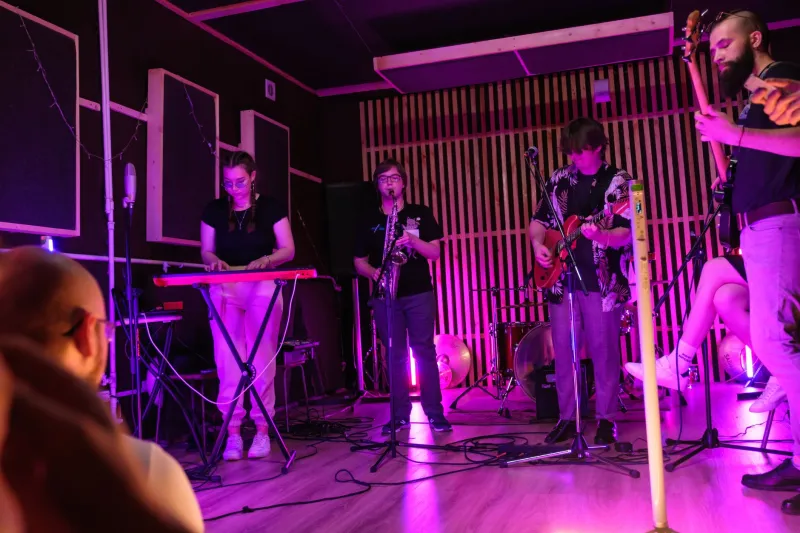
Here's the uncomfortable irony that musicians in gentrifying neighborhoods describe over and over: the new residents love live music. They show up to shows. They spend money at venues. They post about it. But the music they're showing up to see is increasingly not the music that was born in that neighborhood.
Venues adapt to whoever's walking through the door. That's just business. A bar that used to book reggaeton and Latin trap on Friday nights because that was the neighborhood sound starts rotating in indie folk and lo-fi R&B because that's what the new crowd responds to. Nobody makes a decision to erase anything — it just kind of happens, booking by booking, until one day the original artists are looking for somewhere else to play.
Deanna, a singer-songwriter who's been documenting the changes in her city through her music for years, describes it as a slow fade. "It's not like anyone told me I wasn't welcome. The vibe just shifted. The rooms started feeling like they were built for a different story than mine. So you either change your sound or you find a different room."
Some artists change their sound. More than a few will tell you they did it consciously, adjusting their aesthetic to fit the new rooms available to them. Others refuse and end up playing smaller, more underground spots — which, for the record, sometimes produces the most interesting music happening in any given city right now.
The Genres That Emerge from the Friction
It's not all loss, and any honest accounting of what gentrification does to a city's music scene has to include what it accidentally creates. When communities collide — even uncomfortably, even unjustly — sounds collide too. Some of the most interesting artists working in urban spaces right now are making music that's explicitly about that friction.
There's a growing strain of what some producers are calling "displacement rap" — lyrically dense, sonically abrasive, deeply rooted in the specific geography of neighborhoods in transition. Think detailed references to businesses that closed, streets that got renamed, faces that disappeared. It's hyperlocal in a way that streaming algorithms genuinely don't know how to handle, which is part of why it stays underground even when it's undeniably good.
On the other side, you've got artists who grew up in these neighborhoods and are now navigating spaces that were built for people who don't look like them — and making music that sits right in that tension. Not comfortable, not resolved, just honest about where they're standing.
The Venues That Moved and What Got Lost in Transit
Venue relocation is its own chapter in this story. When a club or a listening room gets priced out of a central neighborhood and reopens somewhere on the outskirts — or doesn't reopen at all — it doesn't just lose its address. It loses its foot traffic, its walk-in crowd, its connection to the community that gave it its identity.
A jazz club that moves from a historically Black neighborhood to a more commercially viable district doesn't automatically bring its culture with it. The regulars who couldn't afford to follow, the musicians who built their reputations on that stage, the sound that developed between those specific four walls — that's not portable. You can carry the name. The rest is harder.
Several musicians we spoke to pointed to venue geography as the single biggest factor in how their city's sound has changed. When the rooms move, the scenes fragment. Artists who used to share bills regularly stop running into each other. Collaborations don't happen. The organic cross-pollination that makes a city's music scene feel alive and specific starts to dry up.
Listening for What's Still There
If you want to find the sound your city was making before everything changed — or the sound it's making because everything changed — you have to be willing to go looking. It's not going to land in your algorithm. It's probably not playing at the venues that get written up in the lifestyle magazines that just discovered your neighborhood.
It's in the DIY spaces that haven't been found yet. It's in the community centers that never stopped booking local acts. It's in the parking lot cookouts and the church basements and the backyards. It's in the artists who decided that adapting their sound wasn't worth it and kept making exactly what they were making, for whoever still wanted to hear it.
The city's sound is never just one thing. It never was. But the forces reshaping urban neighborhoods right now are doing something specific to the music — narrowing certain channels, closing certain rooms, relocating certain communities far enough away that their contributions to the sonic landscape become invisible to anyone who wasn't already paying attention.
Pay attention. The version of your city that exists in the music being made right now — all of it, the displaced and the arrived and the ones holding the line — is worth hearing before it becomes something else entirely.