No Algorithm Needed: How Group Chats and Word-of-Mouth Are Still Making Local Artists Famous
Spotify has billions of dollars, machine learning engineers, and more listener data than any record label ever dreamed of. And yet, somehow, the most reliable way to find out about the hottest new artist in your city is still your friend Darnell blowing up the group chat with a voice note saying, "yo, you need to hear this right now."
That's not a knock on the technology. It's just the reality of how music actually moves through a city. And if you talk to the artists, the fans, and the venue owners who are actually in the thick of it, they'll all tell you the same thing: organic buzz built block by block, friend by friend, still hits different than any playlist placement ever could.
The Playlist Promise vs. The Real World
When streaming platforms rolled out their personalized discovery features — your Discover Weeklys, your Daily Mixes, your Release Radars — the pitch was simple. The algorithm knows what you like better than you do. Let it find your next obsession.
For certain kinds of music, in certain contexts, that pitch holds up. If you're looking for a new indie folk artist who sounds like someone you already love, sure, the algorithm can probably deliver. But local music — the stuff that's tied to a specific neighborhood, a specific energy, a specific moment in a city's cultural life — doesn't travel well through those pipelines.
"The algorithm doesn't know what the East Side sounds like right now," says Marcus, a 28-year-old producer who's been working with emerging artists in his city for the past four years. "It knows what sounds like other things that already exist. But when something new is happening here, something that's specific to this place and this time, the algorithm is always going to be late to it."
That latency matters more than people realize. By the time a local artist starts showing up in algorithmic recommendations, the moment might already be half over. The people who were there at the beginning — who caught the wave early — found out a completely different way.
How the Word Actually Spreads
So how does it actually happen? Talk to enough people and a pretty consistent picture emerges.
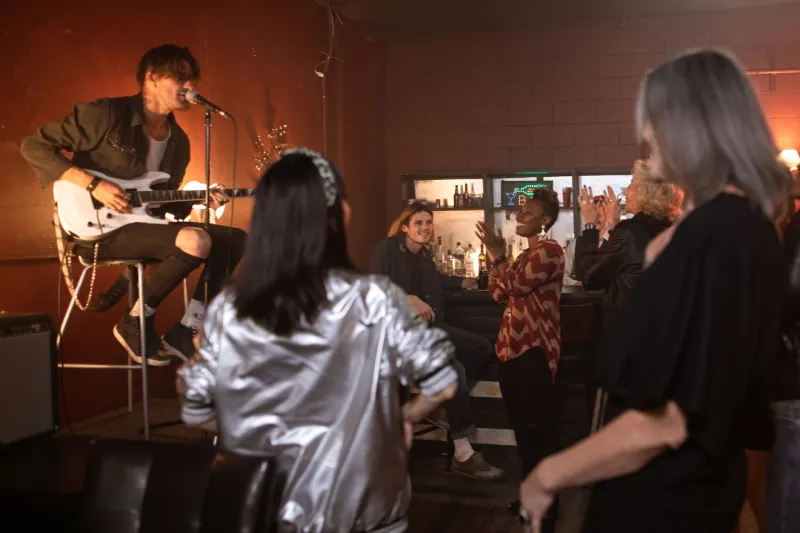
It starts small. An artist drops something — maybe a track on SoundCloud, maybe a short clip on Instagram, maybe just a performance at a 60-person venue on a Tuesday night. Someone in the room, or someone who sees the clip, thinks it's worth passing along. Not posting publicly. Passing along. A direct message. A text. A voice note. An "I need you to hear this" conversation at a house party.
From there it fans out through existing social networks — not social media in the algorithmic sense, but actual social networks. Friend groups. Coworkers. Regulars at a particular bar. People who share a commute or a neighborhood or a scene. The music moves through trust relationships, which is why it carries so much more weight than a playlist suggestion from a machine that doesn't actually know you.
Jayla, a 24-year-old who works at a record shop and has been going to local shows since she was old enough to drive herself, describes it perfectly. "When my friend tells me about an artist, she's putting her taste on the line. She knows I'm going to come back to her and tell her whether she was right or not. That accountability makes the recommendation mean something. The algorithm doesn't have any skin in the game."
What Venues Know That Platforms Don't
The people who run local venues have been watching this dynamic play out for years, and the good ones have learned to read it like a language.
Bar managers and booking coordinators will tell you they can feel when an artist has real word-of-mouth momentum before they can measure it in any concrete way. It shows up in early ticket sales that don't make sense on paper — an artist with modest streaming numbers somehow selling out a 200-person room because the people who know, know. It shows up in the demographic spread of the audience. When a room is full of people who clearly came from different circles, different parts of the city, different scenes, that's word-of-mouth at work. The algorithm tends to deliver monocultures. Genuine buzz delivers a crowd.
"I've had artists with massive streaming numbers play to half-empty rooms," says one venue booker who's worked the local circuit for nearly a decade. "And I've had artists with almost no online presence pack this place because the right people were talking about them. You learn pretty quick which one actually matters."
The Group Chat as Discovery Engine
If there's a single technology that's become the primary vehicle for local music discovery, it might genuinely be the group chat. Not an app built for music. Not a streaming platform. Just a thread of people who trust each other's taste, sharing links and voice notes and half-formed opinions in real time.
Artists who understand this are starting to think about their rollout strategy differently. Instead of chasing playlist placements or paying for algorithmic promotion, they're thinking about seeding music with specific people who are known connectors in their community. Tastemakers who sit at the center of multiple social networks. The person everyone in three different friend groups seems to know.
"I'd rather have ten people with real influence hear my music than ten thousand strangers," says one artist who's been building a following steadily over the past two years without any significant streaming numbers to speak of. "Those ten people are going to tell the right people. And the right people are going to show up."
Why Organic Still Wins
None of this means streaming platforms are irrelevant. Once an artist has built real word-of-mouth momentum, those platforms become useful distribution tools — a place for new listeners to go deep once they've been converted by the group chat or the show or the recommendation from a friend. Streaming and word-of-mouth aren't enemies. They just play different roles.
But for the initial breakthrough — for that first moment when an artist goes from unknown to something people in the city are genuinely excited about — the algorithm still isn't running the show. Real people are. The friend who won't stop talking about a song. The stranger at the show who leans over and says "you've heard these guys before, right?" The group chat that blows up at midnight because someone just found something good.
That's how your city's best new music actually travels. And honestly? It's kind of beautiful that no amount of machine learning has managed to replace it.